The Shortcut to Enlightenment
Posted: August 26, 2013 Filed under: Internet, Philosophy | Tags: Buddhism, internet, philosophy, technology, transhumanism Leave a commentI’m not a transhumanist, and to be perfectly honest I don’t strive to be. While most of the transhumanists I have met have been perfectly nice people, I’m a little too invested in the cyberpunk movement to really believe that science can save us. I also have too keen an appreciation of history, and for all the good that scientific progress has brought (and I’m no Luddite who will claim that science is inherently bad), there is a strong tendency to find ways to misuse and abuse technology, even setting aside the very human tendency to weaponize any scientific advance or discovery that is made. For a couple of examples from recent history, consider either the Fukushima accident or the NSA domestic spying program.
The frontier to which many transhumanists I know are currently looking, and the one that I agree we are most likely to see the next great revolution in human interaction, is the virtual world. The virtual world is already intellectually indistinguishable from the real world, except to the extent that it is superior to the real world (data exchange, etc.) If you don’t believe me, consider how fast conversation happens, how good memory is, how suitable fact checking is without access to the virtual world. Yes, there are issues with the virtual world, but those are issues of emotion, not intellect. When the virtual world becomes physically and emotionally indistinguishable from or superior to the real world, that is the point of singularity. That is also the point at which, lacking other systems, the race will cease to exist, certainly as we know it.
So why would I worry about this? To be honest, I like things more or less as they are. I’ve studied more than a few philosophies and religions to try to understand the world and my place in it, and I’ve had a lot of fun, even if I’ve ended up with more questions than answers. One in particular seems especially relevant to the point at hand.
I’ve come to the decision that I am unlikely to ever be a Buddhist. Buddhism, as I understand it, involves deliberately attempting to let go of earthly pleasures, as pleasure is a source of desire, and desire is the root of suffering. The ultimate goal is the extinguishment of the self, and achievement of nirvana. While I certainly understand and respect that point of view, I happen to feel differently about it. I lean more in the direction that self-understanding is the path of enlightenment, and understanding comes from embracing your passions. Note that I do not necessarily counsel over-indulgence, as that is more often caused by a misunderstanding of some deeper issues, but a true understanding of one’s passions is not necessarily a bad thing, and to understand them you need explore them, and to explore them you must indulge them, at least to an extent. Of course, there was a time in his life when nobody would have expected Siddhartha to achieve enlightenment, much less to be the Buddha, so it may be possible I will change my mind.
But if we somehow do achieve this technological singularity and embody the virtual world (or perhaps it would be more accurate to say the virtual world would embody us), I don’t believe we would have the same passions, the same desires, and in some very real sense we wouldn’t even be the same selves. That’s not to say we wouldn’t be better (as the transhumanists might argue, that’s the whole point of it), but in some ways it seems like abandoning our bodies for a virtual existence would be like a shortcut to Nirvana. Even worse, like any shortcut we would be missing the main road and everything along the way, which is kind of the point of the journey. There are no shortcuts to enlightenment, no matter what your version of enlightenment is.
Face(book)ing the Past
Posted: August 12, 2013 Filed under: Culture, Internet | Tags: culture, digital media, Facebook, internet 6 CommentsThere’s someone on Facebook, and I won’t name names so please let’s nobody else do it either, who won’t accept my friend request. I’ll admit I’m a little hurt, and slightly perplexed, because we were very close in high school and even in college. But then we drifted apart in the way that life happens, and we haven’t spoken in about 15 years. But isn’t that what Facebook is for, at least in part? Reconnecting with people you haven’t seen in years? I’d almost wish there was a “go away, they don’t want to hear from you, and here’s why” response, so that I could at least feel… I don’t know, closure? Satisfaction? Vindication? Then again, there are a few folks I wouldn’t accept friend requests from on a bet, and I have winnowed my own friends list more than once and even targeted a couple people specifically for deletion, so I guess I live in a glass house on this one.
I’ll admit I’m still ambivalent and unsure about Facebook, even though I use it practically every day and have for the better part of a decade now. I was one of the earlier adopters, although I do not say that with any sense of pride. I was on Facebook before there were games or apps, but not by much, and I was one of the people who nearly destroyed Facebook by flooding your feed with endless invitations to games you will never want to play. Yes, I was that guy, and I’m sorry, although in my defense I never played Farmville (although not for lack of invitations, thank you, Mom).
But despite all of that, having completely abandoned the games on Facebook (that’s what smartphones are for) I’ve discovered that it still has its appeal. I’ve connected or reconnected with dozens of people from my past, mostly from high school and college, and mostly people I either never had a relationship with or (perversely) had a very poor relationship with. I have since gone on to develop at least a passing acquaintance with many of them, and even warm online friendships with some of them. It has provided a sense of growth and even soothed some of the old bitterness, taken some of the sting out of the past. It’s also enriched and livened up the present, connected me to or connected me with friends and family, and given me wonderful opportunities to promote crazy ideas and wild ventures.
But then there’s the truly dark side of Facebook: there are people out there, and again I’m not going to name names, who hold materials that were never meant to see the light of day. Old photos and even video that should have stayed buried. The human mind has the capacity for forgetfulness for a reason, and all media fades. This is the true and natural way of things, and dragging the mullet back into the light is just dirty poker. Making baby pictures and bad acting available for public consumption should be banned by the Geneva Convention. You know who you are.
Calling Off the Fall of Civilization
Posted: July 12, 2013 Filed under: Culture, Internet | Tags: America, internet, life, society, technology Leave a commentThere is an ingrained and pernicious belief that the birth of modern communication, and particularly the World Wide Web, has created the ability to form microcosms of communities based around interests, ideas, ideologies and beliefs rather than around the necessity of geography or shared experiences (such as high school). This in turn creates communities that are more extremist in their belief systems, less inclusive and perhaps even xenophobic, and certainly less open to shared experiences than what we used to have “back in the good old days”.
Let’s unpack that a bit and see if there might be some rose tint in those glasses.
Has anyone ever heard the term “northern liberal”? How about “southern conservative”? “Dixiecrat”? Then there’s the notion that “out west is where the weirdoes live”, and we all know about the Left Coast. Then if you really want to get into it there’s the ugly fact of “the black side of town” and other ethnic ghettos (which every wave of immigrants has experienced, including the Irish, Italians, Jews, Polish, Russians, Koreans… and that’s just in New York City), where people would move just to be close to others who were like them (or were “encouraged” to).
It’s not that the internet and other forms of mass communication have insulated us from people like us; it’s only that it’s insulated us from the people we don’t like. It’s enabled us to connect with people that we do share interests and ideas and beliefs with. For example, people would (and still do) go to church…or synagogue, or the place of worship most appropriate to their form of worship… but that only emphasizes my point. You went to the place most like your belief system. Your worldview wasn’t being challenged, it was being reinforced (and if it wasn’t you were being made to conform). In a similar fashion, most sites people visit on the internet will conform to and agree with 90% of their worldview, and the 10% that is being challenged will be a modest challenge at best… just like your place of worship. The difference is that the internet untethers you from physical space; if there is no place you feel comfortable close to you it doesn’t matter, because you can find what you need electronically. Anyone who doesn’t think that’s valuable, or who thinks that what we gain is outweighed by what we have lost, has never been the outsider.
More than that, when people did gather in these geographical or experiential groups of necessity, what was gained in comity and politeness was done so at the expense of real connection. Here’s another older phrase some of you might recognize: “There are certain topics you don’t bring up in polite conversation; religion and politics are at the top of the list.” You didn’t discuss these things (and still don’t at family gatherings) because the neighbors may not and probably don’t agree with you, and unless your intention is to make sure they never invite themselves over again you stick to certain safe topics (usually weather and sports, unless your neighbor is a Browns fan). Usually the goal was polite conversation, for everyone to have a good time and to come back again for more empty conversation and good times and high balls.
The internet has none of these things. There are no high balls, there aren’t many good times, there’s an absolute dearth of polite conversation (although empty conversation still abounds), and trolls lurk under every comments section. But there is at least a chance of having a real conversation, of engaging with another person while everyone else is busy talking past each other, and that chance is better than another night at the Rotary Club knocking back drinks and mouthing empty nothings. Sure, most people just go to places where they know everyone already agrees with them and takes their turn preaching to the choir, but how is that any different than what used to happen in clubs and meeting halls across America before the advent of the internet? Again, the difference is less about the effect and more about the scope; more people talking to each other, mouthing the same words at each other, and a few loners finally finding each other.
Is it paradise? No. But it’s not the end of civilization either.
Quarterly Report
Posted: July 10, 2013 Filed under: Culture, Internet | Tags: culture, internet, pop culture, reviews, toys 2 CommentsThose of you who follow HeelsFirstTravel.com (and that should be all of you, because it’s a great site) should be familiar with Keri’s posts on Birchbox and Glossybox. I’ve always been kind of jealous of the idea of getting packages full of random goodies in the mail, but although there are versions available for men they still focus on personal care products and other things I have zero interest in (but if it sounds like your cup of tea, visit the links above and sign up; Keri deserves the referral credit for turning you on to it).
A few months ago I discovered the online service Quarterly.co. They have a different take on the “random package of goodies” concept. They have a list of contributors who “curate” packages every three months (hence the name of the company) based around a certain theme. The themes range over a wide territory, with everything from the generic “Technology & Toys” or “Travel & Adventure” (curated by Quarterly directly) to more specific mailings from contributors such as Style Girlfriend (a blogger who brings her fashion advice to the real world with her care packages) and Jesse Kornbluth of HeadButler.com, who “sends overlooked gems in film, music, and literature.” There are also some more esoteric offerings, ranging from advice and tools for entrepreneurs from True Ventures (a venture capital firm) to themed mailings like the one from Pharrell Williams of N.E.R.D., who sends mailings based on “curiosity”.
I signed up for the aforementioned Technology & Toys mailing as well as the Laughing Squid package, but what with the timing of the shipments (the name sort of gives it away) it was a bit of a wait before I finally got my first package, and I’d been eagerly awaiting it ever since. Once it finally arrived, I tore it open and found some curious items inside. It seems the theme of this month’s mailing was “physics”, and all the ways you can play around with it. Here are the goodies I received. First, the Airzooka:
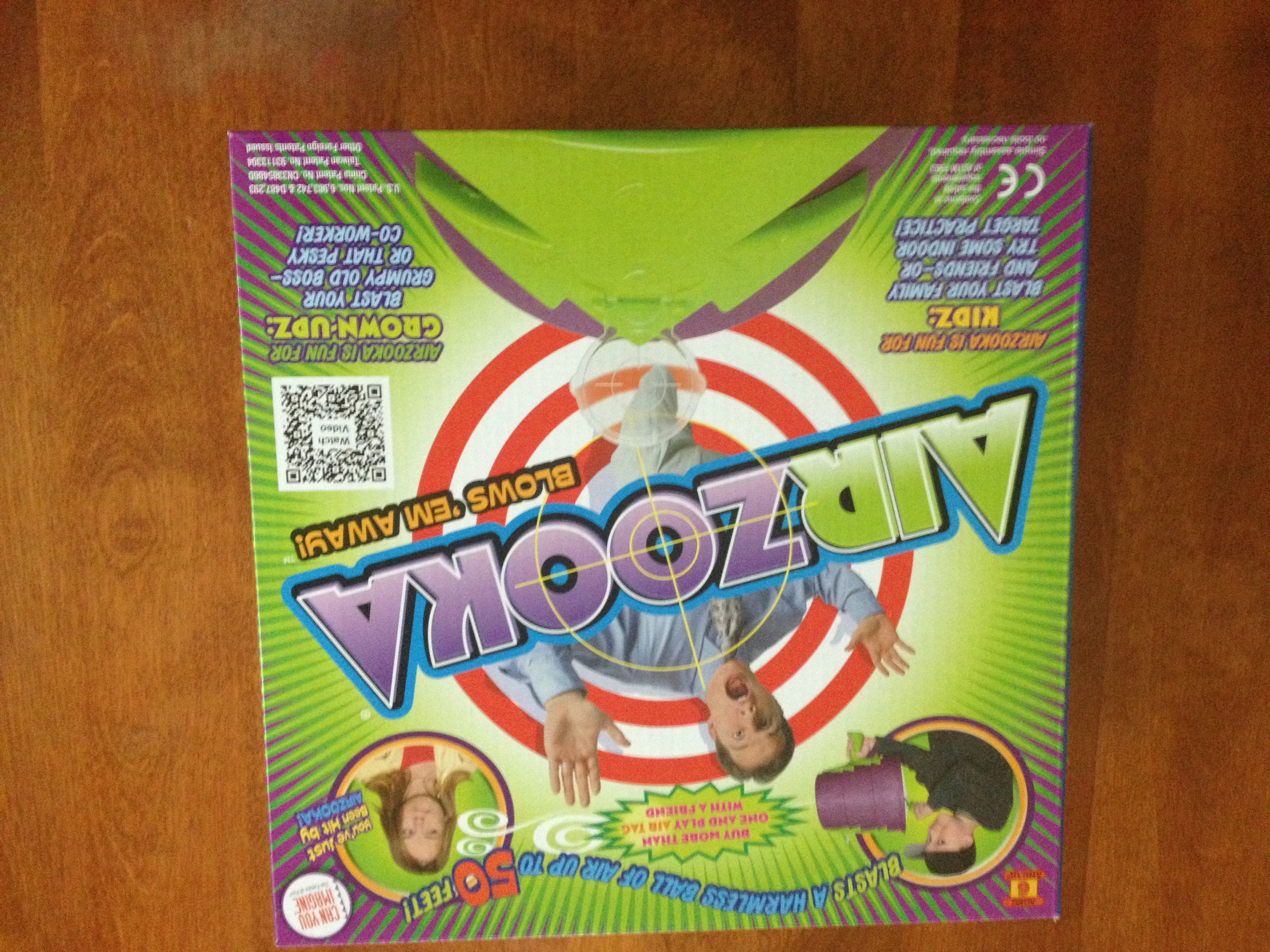
Not as menacing as it looks.
Looks cool, right? Well, it was “some assembly required”.

“I fall to pieces…”
And here’s the final product:

Exactly as menacing as it looks.
When I finally got it together (which only took about five minutes and a small bit of help from My Not So Humble Wife), I did get some fun out of it. It’s a nifty little toy, and I will probably play with it some more in the coming weeks off and on. Still, not the coolest thing ever. Let’s see what else I got.

Not pictured: an actual Australian.
Yes, that’s a Roomarang. As in a boomerang you can throw inside. And yes, it does work about as advertised. It was fun for a few minutes, and I found myself coming back to it a couple times (and might again), but once I finally caught it on the return trip it wasn’t nearly as compelling as it was at first. Next up was the kite.

Things I won’t be doing: impersonating Benjamin Franklin. Starring in Mary Poppins. Thinking of a third kite-related joke.
You will notice it is still in the sleeve. There are a couple reasons for this. First is because it’s summer in Virginia. That means the weather comes in two flavors: hot and humid with no wind or hot and raining. In a couple months if I can still find it the weather might be right for flying a kite. I won’t know because when I was ten I realized I will never be one of those guys who can do cool tricks with kites. I also realized that cool tricks with kites don’t actually impress girls. There may be a correlation there. Either way I won’t be flying a kite again anytime soon.
Next up was a funky lens for my iPhone camera.

This lens wasn’t the only thing getting the fisheye.
You will notice this is also still in the box. The reason for that is before taking the pictures for this blog post, I hadn’t taken a picture with my phone in weeks if not months. I’m just not that kind of guy. I may not be the norm in that regard, but it’s my blog and I’ll cry if I want to. You would cry too if it happened to you. I have no idea where they got the idea I would enjoy this, but at least they were kind enough to send me a postcard when they got there.

“Just like anyone else who sends you a postcard, we clearly have no idea what you like.”
To summarize: 50% of the toys in the box got played with for a couple days, and the other 50% never made it out of the box. That means that I paid $25 each for the Airzooka and the Roomarang. To say I am disappointed would be an understatement. I was expecting bells and whistles, gadgets and toys. Instead I got a physics lesson, a postcard, and a couple of toys.
I’m not giving up on them yet, because I still have high hopes for this mailing, and even if the next one is disappointing there are several others I’d like to try (such as Netted by the Webbies, Joshua Foer, and Alexis Ohanian). If those crap out on me, I’ll just start buying myself $50 worth of random crap off Amazon every few months. Either way I win.
I Need to Be WoW’ed
Posted: June 12, 2013 Filed under: Culture, Internet, Musings | Tags: addiction, culture, entertainment, life, MMO, World of Warcraft, WoW 5 CommentsIt’s been over a year and the cravings are still coming. In fact, of late they’ve been more and more frequent and perhaps even a bit stronger. I think about it at least once a week, and sometimes every day. Sure, it’s worse when I’m bored, but even when I have things going on, it still crosses my mind. “How bad could it be? Just a little bit. I can handle doing just a little bit. I hear they even let you try some for free now.”
Cold turkey sucks.
I’ve quit cigarettes, caffeine, even biting my nails when I was a kid, but somehow the one I seem to be having the most trouble with is World of Warcraft.
Maybe it’s because there’s something missing that I don’t feel like I’m getting in some other way. WoW offers the easy taste of victory early on, with just enough challenge to keep you coming back, and it keeps scaling up to keep the challenge fresh. Sure you can say that about any game, but the folks at Blizzard have it down to a science (quite literally, I’m sure). There’s also a false sense of accomplishment and reward built right in, so you don’t even need to pat yourself on the back; they’ll do it for you. They even let you get something approaching sociability, although the sad truth is they haven’t yet found a way to fix human behavior in an anonymous environment (but they do a better job than most).
Maybe it’s because WoW came to me at the right time in my life (that’s what My Not So Humble Wife suggested). She has a point. When I first started playing World of Warcraft I was feeling lost, alone, and in need of something to make me feel good about myself. I didn’t feel like a success. WoW gave me that. Sure it was an artificial sensation, but Twinkies are full of empty calories and I love them too. WoW gave me so much of that that I spent as much time playing it as I would on a second job, only I paid them for the privilege. Is it a coincidence that a couple months after quitting WoW I started a blog? Not in the slightest. And I still have more free time (most of which I spend with my previously neglected wife).
Maybe it’s because I’ve got an addictive personality. I love to gamble, so I stay away from it. I love to smoke, and I’ve quit more than once (with varying levels of success). I’ll even get hooked on a song and listen to it over and over until I drive the people around me nuts (just ask My Not So Humble Sister; better yet don’t, I don’t need het to be reminded). I’ve thought that if I could find something positive to fill that void (like blogging) it would be enough, but it’s like exercising to get over craving a cigarette. You can only do it so much before you get tired of it, and you still want what you want.
Ultimately I need something to take my mind off of it. I need something that will thrill me, something that will grab and hold my attention long enough to make the cravings go away, I need something so powerful, so wonderful, so fantastic that it’s completely irresistible, to me anyway.
I need to be WoW’ed.
How Episodic Television Shows Are Killing Their Own Business
Posted: April 24, 2013 Filed under: Culture, Internet | Tags: culture, digital media, pop culture, television 1 CommentI watch Netflix about as much these days as I do regular TV, and here’s why: when I can actually get the service to work (thank you Verizon), I can watch entire seasons of shows at once, without having to wait a week at a time, without having to sit through reruns, without having to “choose” between two shows in the same time slot (like I really watch either of them when they come on anyway, it’s called DVR folks), but most of all because I don’t have to sit through commercials.
Unfortunately, I usually have to wait a few years for a single season of a show to hit Netflix, assuming it ever does. I assume this is because they want to make sure to get their money from the first run, the reruns, the syndication, the DVD sales, the syndicated DVD sales, the reruns of the syndicated DVD sales, and whatever all else they do. It’s not until they have a given season running on at least three basic cable channels (or they’ve been passed up by five) that they “stoop” to leasing the rights to Netflix, and even then I’ve seen some shows yank the rights back (I got about five episodes into Babylon 5 before they did this to me).
Why? What do they really think they’re getting out of this? Is there some rabid ocelot in a back room that flails around on a Twister board and they interpret these signals as decisions? Here’s a little clue for you, Oh Great And Powerful Television Executives: the people who bother to watch syndicated television are not the same people who watch Netflix or similar streaming services. Not even close. There may have been, once upon a time, a cross-over audience between those who bought entire seasons of TV shows on DVD and the streaming audience, but that’s a dying trend, too. Only the truly rabid fan base is going to care that much and they will still be there for you (probably wearing a handmade costume piece from their favorite character that you sent a cease and desist order about).
As I see it, there are three primary audiences “second run” television should be aiming for. The first is the hardcore audience, the folks who love a show enough to want everything about it. These folks will buy the entire season on DVD/Blu-Ray, especially if it comes with extras like cast interviews and commentary. The next audience would be the “catch-up” audience. This is what I envision as the folks who only heard about the show from friends well after the season (or the show itself) started and don’t want to jump in halfway through. They want to binge, catch-up to the current storyline, and watch all the first run episodes from there. These are the folks who will watch all the back episodes on a streaming service (small revenue source) and then become more eyeballs for the new episodes, you know, the ones with the most expensive commercials (big revenue source). Finally there’s the casual viewers who like the show well enough to leave it on but don’t consider it “must see” television. This is where you get your syndicated television dollars.
In an ideal world, I envision the lifecycle of a show would be this:
- First run, including all reruns in primetime slot. Season ends.
- As soon as season ends, entire season is available on DVD/Blu-Ray and streaming services. DVD/Blu-Ray includes bonus features.
- Over off-season, previous season reruns in primetime slot.
- After new season starts, last season enters syndication immediately.
The benefit of this system for the viewers is obvious. The benefit for the studios is a little more subtle, but what it means in the long run is less pirating and more eyeballs for first-run content. When people don’t have to feel 2-5 years behind the storyline (unless they feel like coughing up a couple hundred bucks for a show they might or might not like), they’re more likely to get invested. And more invested fans means a higher percentage of rabid fans, which means more DVD sales. The syndicated episodes aren’t going to be hurt any, because the folks who weren’t willing to pay for streaming services are still going to be there, and the ones who did? You grew your audience for those episodes.
The fact that Netflix and Hulu are coming up with their own original programming is just going to hurt these guys even more. Now there are even fewer reasons to be attached to networks and their ridiculous scheduling. I understand once upon a time the system was rigged in such a way that it was winner take all and pitting the best shows against each other meant you had the best chance of crushing the other guy and getting all the money, but here’s a thought: maybe people don’t watch TV that way anymore. Maybe (and this might even date back to the advent of the VCR) people expect to be able to watch ALL the shows they like, not just one or two. Having them all in the same time slots and on the same schedule just seems… well… dumb. But if you have to continue playing that game, at least give yourselves the best chance at a second chance, and stop holding back last year’s episodes until nobody cares anymore.
Free Spoiler Zone
Posted: January 9, 2013 Filed under: Culture, Internet | Tags: culture, etiquette, internet, pop culture, popular culture, society, spoilers 3 CommentsI am the internet’s worst nightmare.
The other night I was listening to Marketplace on NPR (I love Kai Ryssdal, I may have mentioned this before) and I heard a fantastic commentary on the issue of spoilers. Beth Teitell made an excellent case about how we’re all setting ourselves up for spoiler disappointment while at the same time becoming more sensitive to spoilers.
I am the worst of the lot.
Just the other week I finally watched Jekyll (2007) from the BBC on Netflix. Note the year on that one. If someone had told me any of the salient plot points before I watched it, I would have been beyond infuriated, but really, it’s been around for over five years. How could they know? More importantly, why should they care?
This is typical for me. I watch movies months after they leave the theater (with rare exceptions), and I’m usually several weeks behind in my TV show watching. I’ve been known to run away from conversations I’m not even party to with my hands over my ears screaming “NO SPOILERS!” like a lunatic, and that’s just in real life. On the internet I’m far worse.
But the truth is we can’t avoid spoilers, nor can we reasonably expect to. Part of the fun of pop culture is that it’s popular (hence the “pop”), and we want to talk about it. Denying people that just so we can enjoy things on our own schedule is selfish. At the same time, expecting everyone to be able to invest their entire lives in keeping up with everything worthwhile all the time is just silly, too. It’s not like we’re still in the age of single-screen movie theaters, three TV channels, and nobody to talk to but the people in our small towns.
Therefore, I am declaring a Free Spoiler Zone.
It works like this: there is a statute of limitations on the right to declare “NO SPOILERS!” Once the statute of limitations has passed, it is incumbent on each individual to either be in the know or to guard themselves; prior to that proper decorum requires the asking of “Have you seen…” or a similar inquiry before discussing anything, as well as a reasonable warning to anyone joining the conversation. This should help alleviate the distress being caused by our over-saturated, media hyped world, and allow us all some peace.
The rules I suggest are as follows:
1. An absolute moratorium on any communications within 24 hours of an event. Don’t even talk about it; you don’t know who is in earshot. I don’t even want to hear “OMFG THAT WAS SO GOOD!” or “Meh, this week’s episode was okay.” Let me find out for myself, especially if I’m in a different time zone.
2. Barring sporting events, reality TV, or other “real time” entertainment, any electronic communication for the first week must be preceded by the phrase “SPOILER ALERT”. If it’s real time entertainment, after 24 hours you take your chances, but please, don’t be a jerk; if you know someone TiVo’d it, don’t ruin the big game.
3. For all other TV shows, every in-person conversation must include “Have you seen…” or some other socially acceptable form of spoiler alert for one month. After that, you need to either clear out your DVR or climb out from under the rock.
4. For movies you get one month of nobody says nothing. Then all bets are off.
5. Actual news events are exempt from these rules. News should be shared.
6. Feel free to share political shows, commentary, debates, et al to your heart’s content. You deserve what you get.
While I am willing to negotiate on the length of time involved in each rule, I truly believe that following these rules will improve our lives. Everyone will have a free and fair chance to enjoy their quality entertainment without fear of having it ruined, while at the same time encouraging and enhancing the sort of interpersonal relationships we’re losing for fear of not being able to share our love of the great and diverse culture we all enjoy.
However, I am declaring one category of entertainment completely off-limits to spoilers (by special request from My Not So Humble Wife): books. I actually have to agree with her on this one, for a lot of reasons. People read at different speeds, borrow books from each other, and most of all we want to encourage more literacy, not less. Besides, I haven’t finished the Illiad yet, and I can’t wait to find out how it ends.
Classical Liberal, New Media
Posted: January 7, 2013 Filed under: Culture, Internet | Tags: culture, digital media, internet, technology, twitter Leave a commentLast semester I had the good fortune to take a class on Digital Rhetoric and New Media. It was a fascinating class, and it offered me the opportunity to be exposed to a wide variety of new concepts, particularly among them the idea of media specific analysis. To some degree most of us have had some exposure to this, as we don’t analyze movies quite the same way we do books, but we went into it in much greater depth and detail in the class, as well as trying our hands at doing digital art projects.
Coming out of that class, one of the concepts I was introduced to was the idea of “twitter novels” or “twitter stories”. The idea is somewhat flexible (as social media seems to be), but one version of it is taking an existing work and adapting it for Twitter. I was inspired by the idea and decided to try my hand at it. I selected as my source the essay “I, Pencil” by Leonard E. Read, working off the 50th anniversary edition published by the Foundation for Economic Education.
The experience was interesting, to say the least. First I went through the entire essay, trying to break it down into individual tweet-size pieces. This wasn’t as simple as just writing it out 140 characters at a time, because I wanted to accomplish several things with each tweet: I wanted them to seem “real”, I wanted them to be interesting in themselves, and I wanted them to be re-tweetable. Part of making them seem “real” was adjusting the voice of the essay, which is very formal, and making it less so. While I didn’t succeed everywhere, I do think I managed to make it more casual overall. One of the things I discovered in this process is that I am not very comfortable with Twitter; it was only just before I moved into the launch phase that I realized I hadn’t really made use of hash tags, and I had to go back through and find places they naturally fit. I did manage to incorporate bits and pieces of the web here and there, so I feel pretty good about that.
Actually scheduling the project was more of a challenge. Considering the work totaled over 100 tweets, I obviously wasn’t going to be sending them all manually. I had originally planned to send them in half-hour increments (give or take), and after talking with a coworker who is more versed in the use of social media than I am I decided to use Tweetdeck. Now, unless I am missing something, Tweetdeck could be a lot more user-friendly. My original schedule would have stretched out for at least a week (I only intend to have tweets go out between 10 am and 4 pm so I can monitor them for issues), and I had to adjust the schedule. Even being able to keep track of what I had already scheduled was a hassle, as Tweetdeck kept shuffling my pre-scheduled tweets out of chronological order, which does not fill me with confidence. When I tried to reschedule some, it looked like the program has just duplicated rather than rescheduling the tweets. Finally I tried to clear them all out, and upon refreshing things looked fine. Then I deleted that whole column, set it up again, and a whole set of tweets showed up again!
Once I finally got past those difficulties, I started over. I put all my tweets in a spreadsheet and set up a schedule there. I then copied them over and scheduled them rigorously according to the timetable I had established. At the time of writing this they sit queued up, waiting to launch. Over the next few days I’ll see how well the process turned out.
For those who are interested in trying a project like this, here is my advice:
1. Write your tweets in advance. This will give you time to think about what you want to say, make adjustments as needed, and have a cohesive story to present. Don’t think of Twitter (or any other social media platform) as your creative medium; it is your presentation medium. George Lucas doesn’t write the script as he’s filming, neither should you.
2. Think about the medium you are using. What makes it distinctive and unique? Why are you using this medium to tell your story instead of another? In particular familiarize yourself with the conventions of the medium. That’s not to say you can’t break convention (many artists have done so quite successfully), but do it deliberately.
3. Plan, plan, plan. It’s not just the writing, it’s all the tools you will use. If I was more familiar with the ins and outs of Tweetdeck, Bit.ly, and Twitter in general, I would have had an easier time, but just knowing Word and Excel and having a good vision for the shape of the project (I spent weeks working it out in my head) saved me when I hit roadblocks.
4. Have fun with it! In the end this is still an experimental medium, which means there are few if any rules, and this is the chance to do something truly new and innovative.
If you’d like to see my experiment in Twitter writing, it runs this week starting Jan. 7, 10 AM EST at @IPencil2013. If you have your own digital works, please share them in the comments below!
Crowdsourcing My Angst
Posted: December 28, 2012 Filed under: Culture, Internet | Tags: crowdsourcing, culture, internet, Kickstarter 1 CommentI have a problem with crowdsourcing sites like Kickstarter.
Crowdsourcing has not only turned funding for artistic endeavors on its head, it’s removed one very important part of the equation: the people taking a big part of the risk don’t get to share in the rewards. Oh, I understand that the reward is that they get to see a product or piece of art they otherwise might not have (and please don’t say they definitely wouldn’t have; at least half the stuff on Kickstarter these days is things that existed before that site did in one form or another), but they also paid for it. In many cases they overpaid for it, especially compared to the old model.
Consider: I’ve personally kicked in on a couple games and considered kicking in on a few books. The rewards are pretty standard for these things. Below a certain threshold you get a thank-you somewhere, usually on the front page (maybe the welcome screen), although maybe it’s on the back page. Once you get up to the effective retail value of the product, you get a “free” copy. Imagine that. Sometimes around the $15 mark they throw in a t-shirt, which gets rolled in as you hit the next mark that exceeds “current prize retail value + $15”. After a certain point the costs get exceptionally high and the rewards get extremely intangible, such as “lunch with the creators”, but I’m actually okay with those; you can’t really put a price on something like that beyond “whatever the market will bear”, so let ’em get what they can. But here’s one thing they don’t offer: a piece of the action.
Here’s the thing that writers, artists, and lots of other creative types don’t seem to understand. It’s not just that publishers are putting forward the printing presses, the marketing machine, and all the other work they do on your behalf to get your work sold that you think you don’t need them for anymore, and hey, maybe you don’t. The other reason they get a cut of the profits is because of the advance – they loaned you the money you already spent so you could keep body and soul together, and it wasn’t the kind of loan you get from a friend and “I’ll pay you back whenever”. This was a business loan, and it accumulates interest. The interest gets paid in profits, and if there are no profits, you lucked out because they are willing to eat the loss – this time (although they probably won’t take your calls next time).
I understand that at least for Kickstarter there are rules against allowing people to buy into the company, and if I understand the situation correctly this has to do largely with government regulations (no, I am not just trying to sneak in my favorite hobby horse, you can look this up). It has something to do with FTC regulations, unless I miss my guess entirely. But even if there were no government restrictions, I’m not sure the folks who run the site would even allow that sort of thing, because from what I have read (not that I’ve read a lot about them, but there was one article in Time) it would violate their philosophy; the site is there to promote art, not business. Which is fine as a philosophy, but impossible to maintain in reality once you introduce filthy lucre into the equation.
I’d also be more okay with it if their definition of what was an acceptable creative project weren’t so expansive as to be effectively meaningless. Everything from 24-hour dance projects to video game controllers to a bike tire pressure system are projects on the site, in addition to comic books and novels and music and just about anything else. Some of this might never be able to achieve funding if it had to prove being profitable, but some if it easily could, and either way I almost feel like some of it should have to. We already have enough junk products (does the world really need another Slap Chop?), and I can’t help but believe much of the manufactured pieces coming through here will end up being the same. Is it so much to ask that the people who throw in their hard earned dollars get more than a virtual thank you card while the people who make the product get to use someone else’s money to see their dream through?
Maybe it doesn’t seem like much – $1 here, $5 there – but it adds up. And if I could get ten thousand random people across the internet to kick in just $5, I could take off the next year and finally write that novel I’ve been dreaming about, My Not So Humble America. I’d even offer an autographed picture of myself at the $20 level. And just like that, even if I never sell a single copy, I just made enough money to live on for a year in one of the most expensive cities in the world. If the book takes off, I’m even richer, and all it cost me was a few autographed photos.
You know what? Forget everything I said about Kickstarter. It’s the best site ever. And be sure to keep an eye out for my new Kickstarter campaign, coming your way soon.
 . And be sure to leave a review with your not so humble opinion!

 My Not So Humble Opinion