Quarterly Report Redux: The Laughing Squid
Posted: July 29, 2013 Filed under: Culture | Tags: culture, pop culture, reviews 1 CommentWhen I first signed up for packages at Quarterly.co, I chose to go with two different options. The first was the Technology & Toys option, which you can read all about my experience of here. The second was the Laughing Squid curated box which just arrived in the mail the other day.
The theme for this box was “old school”, and I have to say that, for my money, they hit just the right note. As soon as I saw the zine that they created in lieu of a letter, I was hooked.
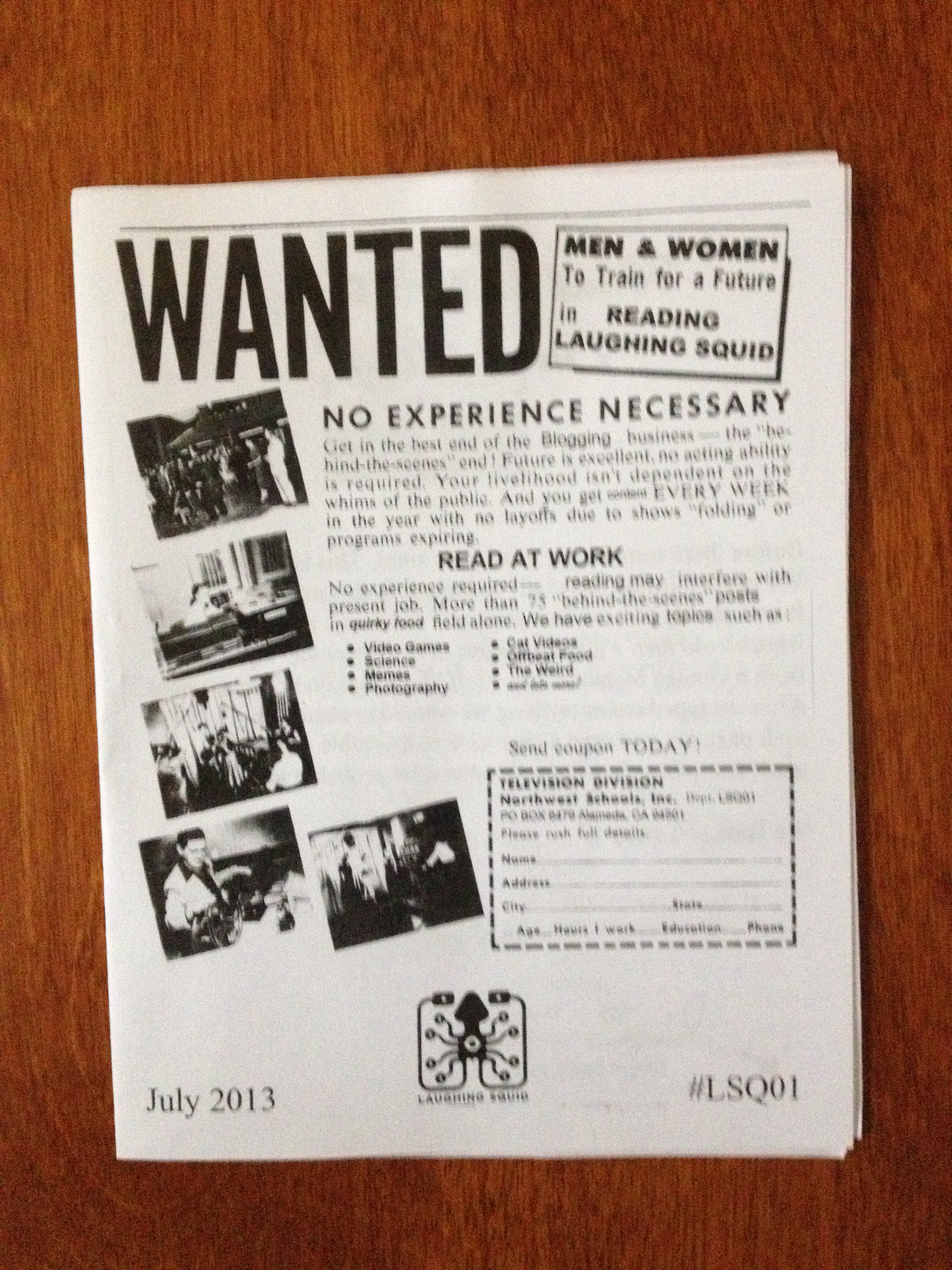
It immediately took me back to my time in college down in Richmond in the mid-90s, and a host of memories came flooding back. The fact that they pointed out such zines were the precursors of blogs such as this one helped bring my past into my present, which (for me at least) was an instant hit.
The next item to grab my attention was the copy of The Tales of the San Francisco Cacophony Society book that they included.
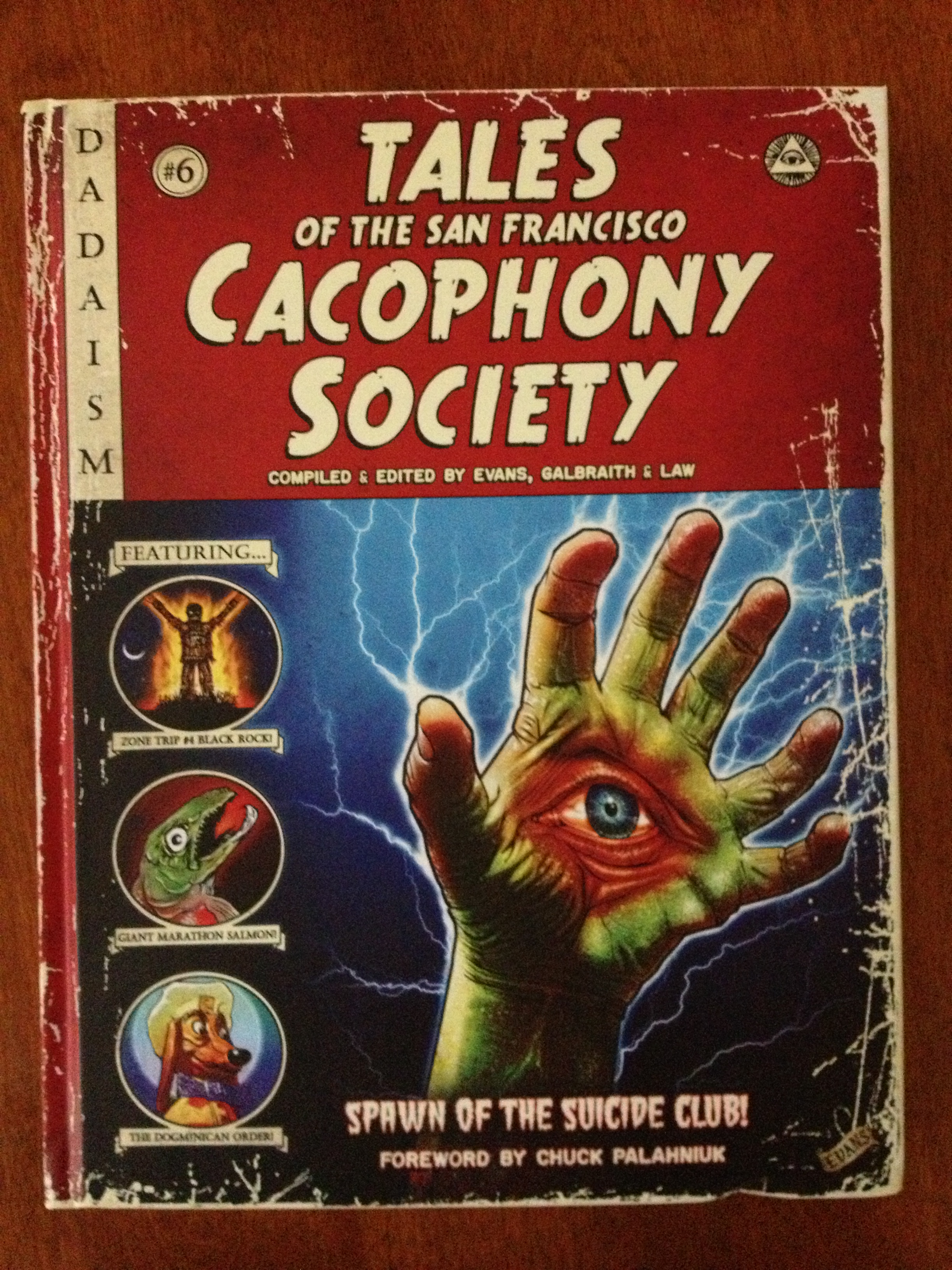
While I am not familiar with it, apparently this is the history (and in some senses pre-history) of the Laughing Squid as well as many other cultural icons, and as a hefty tome weighing in at 300 pages, this looks to be a great read. The cover art is inspired by the old-time pulp comics, and the interior includes some great looking art and photographs. If nothing else, this will make a great coffee table book and conversation piece. Also, if I might take a moment to inject a slice of crass commercialism, the cover price on this one book almost justifies the cost of the Quarterly box by itself, which definitely alleviates any lingering concerns I had from the last box.
The next two items are a combination “starter kit” to get you where they want you to be, and even though I have never tried one the desired result is such a cultural icon I guessed immediately as soon as I saw them what the goal was.

Yes, they sent me the fixings for a Fluffernutter, and as they said in the zine, “all you have to do is add white bread and enjoy!” I have, more than once, thought that I should at least try one of these, if for no other reason than because I want to know what everyone else is talking about. I suppose now I have no more excuses. And if nothing else, I do love my PB&Js, so I’m halfway there.
The final item just tickled me. I have never been a big art collector, but I have always wanted to build a collection. The issue is that, to paraphrase an old joke, art is like pornography; I can’t define it, but I know it when I see it (and I certainly know if I like it). Most art just doesn’t grab me, but the stuff I like I really like, and the print that was included in my box this month hit just the right note of quirky and fun for my taste:

As soon as I saw it, I just had an image in my mind of Cthulhu and friends toasting the end of the world with “Skaal!” and I couldn’t stop giggling. What can I say, I’m weird. This one is getting framed as soon as possible and going up on the wall in my new home office.
So having received two deliveries now from Quarterly, I can definitely say I am overall pleased with the service. The first was fun but less than I hoped for, while the second was more nostalgic and did a lot to tickle my quirkiness. I was definitely thrilled with the Laughing Squid box and can’t wait for the next one.
A Little Slice of the American Dream
Posted: July 26, 2013 Filed under: Musings | Tags: America, American Dream, philosophy, society 3 CommentsIn about a month My Not So Humble Wife and I will be taking a big step and moving into our own place. I know this doesn’t sound like much, but we’ve been living with our current roommates (who are fantastic guys) for the better part of a decade now, and we have never lived on our own together (does that make any sense?). At any rate, it will be a big change for us, but a good one, and one I feel ready for, despite the fact that I’ve never lived without a roommate and/or fewer than three family members at once.
While I was talking about it with a friend at lunch the other day, I realized why I’m so excited about this move. What it really comes down to is that we’re finally going to capture a little slice of the American Dream. Sure we won’t own our own home, but I think the American Dream is more basic than that, more primal. I think it all comes down to autonomy.
When you go all the way back to the beginning, the American Dream was about owning land. Even if it was just a small piece of land, it was still yours, to do with as you please, and no lord or master to tell you otherwise. Coming out of an age of feudalism and many countries that still operated along socioeconomic systems that were barely removed from feudalism despite the Black Death, this was no small thing; it was everything. It was, quite literally, the American Dream.
As the country became more urbanized and people moved into the cities, owning your own business became the new aspiration. But why? More often than not you would have to work the same long hours for little money, and the only difference from being a laborer was that you couldn’t just pick up in the middle of the night and leave if things went sideways. But what you did have was self-determination. You were your own boss. In an age when the bosses made all the rules, this was no small thing; it was everything. It was, quite literally, the American Dream.
Fast forward a ways to when the cities started pushing out into the suburbs. The single family home, the fenced yard, the 2.5 kids and a car in the garage (the car, not the kids), all of this was what people longed for. Even if it meant you had to be away from home longer because you had a commute, and there was always the terrible traffic to consider, and maybe you didn’t get to know your neighbors as well, it was all worth it in the end. Why? Because your space was yours. Every house a castle, and every man a king. In a time when radio and television were bringing the world into your living room, this was no small thing; it was everything. It was, quite literally, the American Dream.
And so it goes. America has always been a culture that values the individual. There are other countries, like Japan, that have cultures prioritizing the community over the individual, and those are fine cultures, but they are not ours. The American Dream is and always has been about self-reliance, self-ownership, and self-discovery. Autonomy is at the heart of who we are, what we believe, and what we desire, and there’s nothing wrong with that. Even when we form, join, or participate in communities, it is as individuals coming together, not communities deigning to acknowledge the individual from time to time.
And so at last we will be starting down the road of that American Dream, together.
Step Up to the Plate
Posted: July 24, 2013 Filed under: Musings | Tags: doping, society, sports 2 CommentsOnce again it seems that Major League Baseball is facing a doping scandal, although hopefully this time it will be a minor one. I would say I’m surprised, but then even I wouldn’t believe me. Doping scandals in professional sports have become more common than paternity tests, and I for one don’t really understand why when there seems to be a simple solution. Let ‘em dope.
Here’s how I see it. The great myth of professional sports these days is that these players are at the height of physical perfection, having worked for years to hone their bodies, their skills, and their natural talent all for love of the game. Does anyone even begin to believe that line of bullshit anymore? Even a little? That was the same line they sued to feed us about the Olympics, and that was back when people barely even watched them (as opposed to now, when people… oh, wait.) Then the Olympic Committee finally admitted that the Olympic athletes really were basically professional athletes (and some of them were professionals in fact as well as in theory) and finally changed the rules of the game. Maybe it’s time professional sports had a similar moment of self-realization.
Most people don’t watch professional sports because they want to see a well-executed play handled with grace and skill. They watch because they want to see a 100-MPH fastball or an out of the park homerun. Passing is passé; they thrill to see the perfect three-point shot or awesome slam dunk. Even golf isn’t immune. Talk all day about a great short game if you want, it’s the guy with the 425 yard drive who gets people excited. So why not give the people what they want?
I’m not suggesting that dopers should be let off the hook. They knew the rules going in, and they decided not to abide by them. For every doper in professional sports (whether or not they’ve been caught), there’s somebody who played fair that never got to go to the Big Show. But does it really make that much of a difference to kick them out for a half a season, or even an entire season, if they just get to come back? Does that really send the message “don’t do it”, or does it send the message “don’t get caught, and if you do make sure you have a good lawyer”?
Instead, how about having two separate leagues? One league can be just like the leagues we have now, where any sort of doping is forbidden, only in my vision of things if you get caught you get bounced. No suspensions, no probation, just one and done, you’re out, no exceptions. In the other league you can do any sort of artificial enhancement you and your conscience can agree to, as long as it’s legal in the country you had it done, and you also have to register with the league all the enhancements you’ve had done (and no, I don’t care if you think it’s not relevant to your performance. We’ll decide that.)
In this vision of sports, we’ll be able to sort out what the people really want. Do they truly care about “the height of physical perfection” and players’ “love of the game”? Or is it all just about the biggest, wildest spectacle possible? We might learn as much about ourselves as we do about our athletes.
Memory as Identity
Posted: July 22, 2013 Filed under: Culture, Musings | Tags: culture, entertainment, movies, philosophy, pop culture, sci-fi, science fiction, television Leave a commentAs I was doing laundry the other day (which doesn’t happen often, but it does happen) I was thinking about the last season of Fringe. Of course, this being the internet it doesn’t matter how old that show is, so allow me a moment for the following:
WARNING! WARNING! SPOILERS AHEAD! I WILL BE DISCUSSING TELEVISION SHOWS AND MOVIES THAT HAVE BEEN OUT FOR AT LEAST A YEAR OR LONGER. PLEASE AVERT YOUR EYES IF YOU HAVE NOT SEEN THEM AND STILL CARE.
Ahem. As I was saying. I got to thinking about the last season of Fringe, and in particular the way that the entire season wrapped up by resetting the timeline in the final episode. It seemed a little jarring in some ways, not least because it was the latest in a string of retcons and hard resets that the series had come up with that in my memory can only be topped by Eureka (no, that’s not a spoiler, Eureka spoiled itself. Seriously.) The part of it that I found most disturbing however was that in some ways it seemed to invalidate all the struggles, sacrifices and triumphs of all the characters throughout the entire fifth season. After all, if the events in question never happened, then they have no meaning, right? Or do they?
Pop culture and philosophy might seem like strange bedfellows, but they have gone together at least as far back as ancient Greece. After all, what we think of as great tragedies from that time were presented during the Dionysian festival, and we all know what kind of god Dionysus was (here’s a hint: grab a bottle of wine and get loaded. You’ll be on the right track.) These were the pop culture of their day, and yet they dealt in questions of philosophy, identity, madness (no big surprise, considering the venue), and the human soul.
So what does all of this have to do with my thoughts on the finale of Fringe? I got to thinking “did those characters truly cease to exist?” After all, if they had not taken the actions they did, the timeline wouldn’t have reset, ergo the reset is proof that they did exist, and they did indeed make their sacrifices, even if they and nobody else remembers them (which also goes back to season four to some extent). So what is the relationship between memory and identity? Are we only what we remember? If we don’t remember who we are, do we cease to exist?
Another pop culture/sci-fi look at this concept is Dark City. A fantastic film from 1998 that doesn’t get nearly the mentions it deserves, this movie plays around with the concept of memory and identity and the interaction between the two almost to an obscene degree. While it takes a very definite position on what it means to be human, it doesn’t really address the essential question of identity. Everyone in the city is memory-wiped and essentially reprogrammed as a new person several times throughout the film, and yet each person seems to have some consistency as an individual. Is this because the wipe wasn’t complete, or is there something more?
A relevant experience from my own life was when I went in for a fairly routine procedure at the doctor’s office a couple years ago. He put me under with some new drug that I don’t recall the name of, but apparently the effect was I was conscious for the entire procedure, only I was unable to process any of the events into long-term memory. So I have no memory of the procedure, nor the first two times I asked him if he was done. (Seriously, he told me I asked him the same question three times.) So here’s the question: did I exist? Physically, obviously, my body was present. But did I exist as a person? If I did, what does it mean that I have no memory of that time? If I was conscious, aware, and able to process information, but no memories of any of it exist or ever will, what does that mean?
I guess it means the same thing as the end of Fringe or Dark City: take away from it what you want. Show’s over. Roll credits.
Why I Don’t Give a Shit
Posted: July 19, 2013 Filed under: Humor | Tags: adult, comedy, humor 6 CommentsLadies and gentlemen, I am sorry to say that at this time I do not and cannot give a shit. I have not yet run out of give a shit, but I am perilously close to running out, and I have had to start carefully rationing my give a shit. At one point in time I was full of shit and could shoot the shit all day long, but I got the shit beat out of me and that is no longer the case. I hope that none of you take this personally, as it is nobody’s fault, except for perhaps that one guy who did that really interesting thing the other day quite unexpectedly. I had not budgeted for giving a shit about that, and it left me with a serious deficit of give a shit all day long.
You may have noticed that we are currently in a recession, and are likely to see economic conditions continue to be as shitty as they have been at least through the rest of this fiscal quarter and into the next. That being the case, you would think the government would make it easier to give a shit by producing some cheap shit just like they are producing cheap money, but instead all they keep doing is giving us expensive shit, calling it free shit and making us pay through the nose for this shit. This is surprising, considering how much bullshit they produce in Washington every day.
We have tried importing some shit from China, but that shit is extremely low quality shit for what you get. The shit they have in Europe is severely overpriced, which helps explain why they are up shit creek without a paddle. This would also help explain why the Germans, who are single-handedly supporting the shitty European economy, always look constipated.
Lacking any sort of meaningful government support, I will be forced to attempt to turn to private solutions. Unfortunately I don’t know anyone else who gives a shit either, so I’m shit out of luck. There was a time when I couldn’t give this shit away, but that time is long past. I tried turning to the church in hopes of getting some holy shit, but that shit just didn’t fly. Turns out bears are not Catholic and the Pope does not in fact shit in the woods. I figured I could try the zoo, because they’re always shoveling the shit, but the shit they had wasn’t worth a shit; it was just the same shit, different day.
When I finally get my shit together, I’ll feel like king shit, and I assure you I won’t forget the rest of you – this shit will roll downhill. If you think you’re too old for this shit, tough shit. It’ll be time to shit or get off the pot. When the shit hits the fan you better be ready to go ape shit or you’re going to be in deep shit.
I shit you not.
A Year and a Day
Posted: July 17, 2013 Filed under: Musings | Tags: life 8 CommentsFair warning: this post is going to be a bit of a downer. If you want something to cheer you up, here’s a video of some baby pandas on a slide.
So yeah. Yesterday was the anniversary of my father’s passing. Which is a nice euphemistic way of saying I lost one of the greatest men and influences in my life, and my entire family and the world was diminished. Not something you want to denote with an “anniversary”, and yet it was something I couldn’t avoid being aware of for several days beforehand and dwelling on for most of the day.
And now today is “a year and a day”. Historically this is a length of time with great significance, with many precedents. Of particular interest to me is the notion of mourning for a year and a day. I actually thought about this (not coincidentally) about a year ago, when I realized very quickly all the holidays and other events that would be coming up without Dad around to see them. Every one of them would be “the first (insert holiday) without Dad”. And yesterday was the first anniversary of his passing, which was the one holiday I never wanted to have, with or without him (although I suppose having it with him would have been odd and more than a little creepy). And so… today is a year and a day. There are no more “firsts” to endure. Everything has been trodden, everything is old hat, or at least as much as it ever will be. Each day that follows will no longer be “the first time without Dad”. So what do I make of it instead?
I have decided that I am going to make this year about reclamation. I am going to take back every single day that I lost. Not that I regret mourning, because I needed to take the time to understand what I felt, to get through it, and be able to move on from what happened. But that time is over, and more importantly so many other times in my life are over, times that had become old and stale and lost their meaning long before I was willing to let them go, and I have at last decided I am ready to let go of all of it.
Starting today, I am reclaiming my life, and I am reclaiming myself. I have let too many things languish, and I have let too many things stagnate. I have decided to give myself a year and a day to make a change, a real, positive, and noticeable change in my own circumstances. Life is for the living, and I am tired of merely existing.
Who’s with me?
I Don’t Belong to the City
Posted: July 15, 2013 Filed under: Musings | Tags: cities, society, urban living Leave a commentI know there are people out there who love the feel of living in a city. They love the pulse and rhythm of the urban environment, they enjoy all the wonderful cultural benefits that a city provides, and they just thrive in being a part of that tapestry of humanity.
I am diametrically opposed to those people.
I’ve tried living in cities before. I’ve lived in Richmond, VA, and I’ve lived in Indianapolis, IN, as well as being close enough to Washington, DC most of my life to be able to make a go of it any time I want. The fact is I can’t stand city life, not even for a visit, and I would despise living there. The handful of cities that I have visited have almost universally been a disappointment, and I truly cannot comprehend why people rave about them (either individually or the urban landscape as a concept).
My reasons for hating on cities are many and varied. The first is the people. Not just the seething mass of humanity that presses in on you constantly from all angles like the worst version of a zombie film ever (although clearly that’s an issue for me), but the sheer fact that the human capacity for politeness seems to be directly proportional to the amount of square footage they have available to them. The more people you pack into a given area the less polite they tend to be, and cities generally allow 2 square inches per person. I grew up in the suburbs, where getting within arm’s length of someone else was either an invitation to make-out or initiating a fight, so this is more than a little disturbing to me (I understand that if you grow up in rural areas being within shouting distance of another person makes you claustrophobic, but I could be misinformed).
The second reason I hate cities is the traffic. Talk to me all day about public transit, but I’ve taken public transit before and I’ll never make that mistake again. Not only does it expose me to other people in close proximity (see above), but it’s inconvenient and occasionally dangerous… on a good day. Traffic in most cities is frustrating, maddening, and in some cases life-threatening, but at least I have my own vehicle for it. The pedestrians and bike riders are even worse, being the most dangerous hazard on the road right after the other cars, but at least they bounce off. Of course this leads to the issue of parking, of which there is none, unless you’re willing to pay more to park your car than you did to go to college.
The next thing I hate about cities is the atrocious service you get practically everywhere. Granted this isn’t universal but it comes pretty close. I’ve gotten bad service in the ‘burbs, but it seems like cities make an art form out of it. Something about the knowledge there’ll be another one right behind you (and usually they are, in fact, right behind you – it’s called “personal space” folks) seems to lead these companies to think they can get away with murder. Except the hit men; they don’t even bother. The worst part is they’re usually right, because I see these companies staying open well past the point I would expect even a Mafia front to shut down due to lack of business.
Even worse than the service is the prices. Now I get supply and demand as well as the next guy. I just don’t get the demand. When apartments the size of my walk-in closet are going for as much as my entire house I have to start questioning the sanity of all parties involved. Do I love my commute? Of course not! I have to deal with people who are even worse drivers than I am, and that’s a distinction that takes some serious effort to achieve. But I do enjoy eating something other than ramen noodles every day of my life.
With all that in mind, here’s my top five list of cities I would never live in on a bet:
5. Richmond, VA: Been there, done that, just barely got out alive. And I mean that literally. There are some parts that aren’t as bad as others, but on the whole there’s so little to recommend it it’s not worth the effort to even drive through.
4. Arlington, VA: Everything I hate about Washington, DC with none of the redeeming features. Even worse, it forces me to acknowledge that DC has redeeming features. I hate that.
3. Washington, DC: What’s not to hate about DC? The politicians, the government (local and federal), the street layout, the pretentiousness… and that’s just the nice parts of the city.
2. New York City, NY: I despise NYC. Sorry, had to get it out there. This is a town so very full of itself that rides way too high on way too little. I’ve been there and frankly I just don’t get what the hubbub is all about. At least LA is warm.
1. Chicago, IL: Here’s another one that’s riding on the past and has nothing to show for it. Seriously, unless you like sports… I take that back, even if you like sports there are better towns. This place is a dirty, smelly, rundown dump, and that’s if you DON’T include Gary, IN.
So there you have it, one man’s ode to urban existence. Feel free to add your own favorites to the hate parade in the comments below.
Calling Off the Fall of Civilization
Posted: July 12, 2013 Filed under: Culture, Internet | Tags: America, internet, life, society, technology Leave a commentThere is an ingrained and pernicious belief that the birth of modern communication, and particularly the World Wide Web, has created the ability to form microcosms of communities based around interests, ideas, ideologies and beliefs rather than around the necessity of geography or shared experiences (such as high school). This in turn creates communities that are more extremist in their belief systems, less inclusive and perhaps even xenophobic, and certainly less open to shared experiences than what we used to have “back in the good old days”.
Let’s unpack that a bit and see if there might be some rose tint in those glasses.
Has anyone ever heard the term “northern liberal”? How about “southern conservative”? “Dixiecrat”? Then there’s the notion that “out west is where the weirdoes live”, and we all know about the Left Coast. Then if you really want to get into it there’s the ugly fact of “the black side of town” and other ethnic ghettos (which every wave of immigrants has experienced, including the Irish, Italians, Jews, Polish, Russians, Koreans… and that’s just in New York City), where people would move just to be close to others who were like them (or were “encouraged” to).
It’s not that the internet and other forms of mass communication have insulated us from people like us; it’s only that it’s insulated us from the people we don’t like. It’s enabled us to connect with people that we do share interests and ideas and beliefs with. For example, people would (and still do) go to church…or synagogue, or the place of worship most appropriate to their form of worship… but that only emphasizes my point. You went to the place most like your belief system. Your worldview wasn’t being challenged, it was being reinforced (and if it wasn’t you were being made to conform). In a similar fashion, most sites people visit on the internet will conform to and agree with 90% of their worldview, and the 10% that is being challenged will be a modest challenge at best… just like your place of worship. The difference is that the internet untethers you from physical space; if there is no place you feel comfortable close to you it doesn’t matter, because you can find what you need electronically. Anyone who doesn’t think that’s valuable, or who thinks that what we gain is outweighed by what we have lost, has never been the outsider.
More than that, when people did gather in these geographical or experiential groups of necessity, what was gained in comity and politeness was done so at the expense of real connection. Here’s another older phrase some of you might recognize: “There are certain topics you don’t bring up in polite conversation; religion and politics are at the top of the list.” You didn’t discuss these things (and still don’t at family gatherings) because the neighbors may not and probably don’t agree with you, and unless your intention is to make sure they never invite themselves over again you stick to certain safe topics (usually weather and sports, unless your neighbor is a Browns fan). Usually the goal was polite conversation, for everyone to have a good time and to come back again for more empty conversation and good times and high balls.
The internet has none of these things. There are no high balls, there aren’t many good times, there’s an absolute dearth of polite conversation (although empty conversation still abounds), and trolls lurk under every comments section. But there is at least a chance of having a real conversation, of engaging with another person while everyone else is busy talking past each other, and that chance is better than another night at the Rotary Club knocking back drinks and mouthing empty nothings. Sure, most people just go to places where they know everyone already agrees with them and takes their turn preaching to the choir, but how is that any different than what used to happen in clubs and meeting halls across America before the advent of the internet? Again, the difference is less about the effect and more about the scope; more people talking to each other, mouthing the same words at each other, and a few loners finally finding each other.
Is it paradise? No. But it’s not the end of civilization either.
Quarterly Report
Posted: July 10, 2013 Filed under: Culture, Internet | Tags: culture, internet, pop culture, reviews, toys 2 CommentsThose of you who follow HeelsFirstTravel.com (and that should be all of you, because it’s a great site) should be familiar with Keri’s posts on Birchbox and Glossybox. I’ve always been kind of jealous of the idea of getting packages full of random goodies in the mail, but although there are versions available for men they still focus on personal care products and other things I have zero interest in (but if it sounds like your cup of tea, visit the links above and sign up; Keri deserves the referral credit for turning you on to it).
A few months ago I discovered the online service Quarterly.co. They have a different take on the “random package of goodies” concept. They have a list of contributors who “curate” packages every three months (hence the name of the company) based around a certain theme. The themes range over a wide territory, with everything from the generic “Technology & Toys” or “Travel & Adventure” (curated by Quarterly directly) to more specific mailings from contributors such as Style Girlfriend (a blogger who brings her fashion advice to the real world with her care packages) and Jesse Kornbluth of HeadButler.com, who “sends overlooked gems in film, music, and literature.” There are also some more esoteric offerings, ranging from advice and tools for entrepreneurs from True Ventures (a venture capital firm) to themed mailings like the one from Pharrell Williams of N.E.R.D., who sends mailings based on “curiosity”.
I signed up for the aforementioned Technology & Toys mailing as well as the Laughing Squid package, but what with the timing of the shipments (the name sort of gives it away) it was a bit of a wait before I finally got my first package, and I’d been eagerly awaiting it ever since. Once it finally arrived, I tore it open and found some curious items inside. It seems the theme of this month’s mailing was “physics”, and all the ways you can play around with it. Here are the goodies I received. First, the Airzooka:

Not as menacing as it looks.
Looks cool, right? Well, it was “some assembly required”.

“I fall to pieces…”
And here’s the final product:

Exactly as menacing as it looks.
When I finally got it together (which only took about five minutes and a small bit of help from My Not So Humble Wife), I did get some fun out of it. It’s a nifty little toy, and I will probably play with it some more in the coming weeks off and on. Still, not the coolest thing ever. Let’s see what else I got.

Not pictured: an actual Australian.
Yes, that’s a Roomarang. As in a boomerang you can throw inside. And yes, it does work about as advertised. It was fun for a few minutes, and I found myself coming back to it a couple times (and might again), but once I finally caught it on the return trip it wasn’t nearly as compelling as it was at first. Next up was the kite.

Things I won’t be doing: impersonating Benjamin Franklin. Starring in Mary Poppins. Thinking of a third kite-related joke.
You will notice it is still in the sleeve. There are a couple reasons for this. First is because it’s summer in Virginia. That means the weather comes in two flavors: hot and humid with no wind or hot and raining. In a couple months if I can still find it the weather might be right for flying a kite. I won’t know because when I was ten I realized I will never be one of those guys who can do cool tricks with kites. I also realized that cool tricks with kites don’t actually impress girls. There may be a correlation there. Either way I won’t be flying a kite again anytime soon.
Next up was a funky lens for my iPhone camera.

This lens wasn’t the only thing getting the fisheye.
You will notice this is also still in the box. The reason for that is before taking the pictures for this blog post, I hadn’t taken a picture with my phone in weeks if not months. I’m just not that kind of guy. I may not be the norm in that regard, but it’s my blog and I’ll cry if I want to. You would cry too if it happened to you. I have no idea where they got the idea I would enjoy this, but at least they were kind enough to send me a postcard when they got there.

“Just like anyone else who sends you a postcard, we clearly have no idea what you like.”
To summarize: 50% of the toys in the box got played with for a couple days, and the other 50% never made it out of the box. That means that I paid $25 each for the Airzooka and the Roomarang. To say I am disappointed would be an understatement. I was expecting bells and whistles, gadgets and toys. Instead I got a physics lesson, a postcard, and a couple of toys.
I’m not giving up on them yet, because I still have high hopes for this mailing, and even if the next one is disappointing there are several others I’d like to try (such as Netted by the Webbies, Joshua Foer, and Alexis Ohanian). If those crap out on me, I’ll just start buying myself $50 worth of random crap off Amazon every few months. Either way I win.
Opening the Black Box
Posted: July 8, 2013 Filed under: Musings | Tags: society, technology Leave a commentI’ve been having technology problems the past week. First my new computer (that should be able to orbit Jupiter) quit playing any sound. In a withering blast of irony this happened right as I bought a new set of Bose speakers for the system to end all systems. At the same time our house A/C went on the fritz… again. What do these two things have in common, besides driving me to my knees in anger and frustration? Mostly they reminded me of the black box society we live in, and the misconception that this is a recent phenomenon.
Ever since computers became a common household fixture, I have heard people talking about “black box technology”. If you aren’t familiar with the term, the idea is that technology has become so complex that the average person can’t open it up, tinker with it, and figure out how it works. I think this misconception derives at least to some extent from the middle of the 20th century when for the first time we had a large middle class that was largely educated and technically savvy, thanks in no small part to having spent time in the military (where they were exposed to and forced to learn how to fix a wider variety of technology than ever before). This also lead to a generation of “gearheads”, guys who enjoyed working on their cars and taught their sons to work on them too (I guess their daughters got taught how to bake; don’t look at me, it was the Fifties).
But just because little boys were putting together ham radios and big boys were tinkering with fully assembled automobiles doesn’t mean that all of technology was somehow an open book. There were tech trade schools even back then, although the societal meme at the time was “typewriter repairman” rather than ITT Tech. But they both serve the same purpose, and for the same reason: there is abundant technology that the average person uses all the time and has no notion of how to repair.
As I was growing up, I had a lot of friends who would assemble their own computers (I had neither the money, the skill, nor the patience). Some even made good money doing this for other people, because this was a “black box technology” even though computer assembly even today is basically just like Legos: snap the pieces together and start it up (just make sure to snap the right piece in the right slot). It’s actually easier than it used to be, because things are better labeled and systems are more forgiving. But for the life of me I still can’t get my sound card to work, and I still had to call out a repairman to work on my A/C (who’s a great guy, by the way). HVAC has been around for a long time as well, and they have had trade schools for that as long as I can remember, so why is it that neither I, my wife, nor either of my roommates, all of us reasonably intelligent and reasonably well-educated, had any idea how to fix it?
The black box is nothing new. We just have more black boxes than ever before, and we’re more afraid than ever to open them up.
 . And be sure to leave a review with your not so humble opinion!

 My Not So Humble Opinion