Dating Advice From Classical Deities
Posted: February 13, 2013 Filed under: Culture, Dating, Humor | Tags: advice, culture, dating, humor, mythology 2 Comments
Marie-Lan Nguyen / Wikimedia Commons (Public Domain)
Hera
Dear Hera,
I have been married for about six months now, and I’m starting to worry about my relationship. My husband and I used to go out all the time, but lately he stays late at work a lot, and when he comes home he just eats dinner and then watches TV until bedtime. He never seems to have time for me anymore, and on the weekend he goes out with his buddies. We don’t talk like we used to, and I’m afraid there may even be another woman. I’ve thought about looking through his email and his text messages, but if I didn’t find anything I’d feel like a horrible person, and if I did find something that would be even worse. I just don’t know what to do. Please help!
Signed,
Desperate Housewife
Dear Concerned Matron,
It is an unfortunate fact that so many of our children have been raised on fairy tales to believe that all it takes is a magic ceremony to create the perfect circumstances for “happily ever after”. What the stories don’t prepare you for is the lifetime of work that follows. A marriage is more than simply living together in domestic bliss; it is a partnership, and one that must be cared for, nurtured, and treated well, lest it die from inattention. I am encouraged to hear you have not yet taken the irreversible step of violating your husband’s trust; a good marriage is built on trust and mutual respect, and once broken it can be almost impossible to recover. Believe in him, and surely you will be rewarded. Rather than snooping, try talking to him. Find a time when you can both be calm and relaxed and share your concerns; likely he has some of the same fears, and by sharing them you will strengthen your relationship. Confrontations don’t solve anything, but conversations can be the beginning of a better life for you both.

Tyr and Fenrir in for Our Fathers’ Godsaga by Viktor Rydberg/ Public Domain (Wikimedia Commons)
Fenrir
Dear Fenrir,
My family just doesn’t get me. They’re a bunch of straights, and I want to have fun while I’m still young enough to enjoy it! So I go out and have a good time, and yeah, I date some crazy women, but it’s not like I’m hurting anyone! I’m careful, I use protection, and we’re all consenting adults. Why can’t they just get off my back already?
Signed,
Black Sheep
Dear Wild Child,
Family, am I right? You get just a little bit out of line and they can’t wait to chain you down with responsibilities and their “vision” of what you should be. Here’s the thing though: they really do care about you, and even though you think you’re not hurting anyone, you also may not be looking at the bigger picture. Are you considering where you’ll be in five years, or fifty? Parties are great while they last, but sooner or later the party winds down, and they’re worried you’ll be the lone wolf without anyone to go home to. Give it some thought, let them know you understand their fears and show them you have a handle on where your life is headed, and maybe they won’t object so much if you go out and howl at the moon once in a while.
Huitzilopochtli

Huitzilopochtli, from the Codex Telleriano-Remensis (16th century) (Public domain/Wikimedia Commons)
Dear Huitzilopochtli,
My girlfriend and I are always fighting. I have no idea why. Sometimes I think we just like to fight. The making-up part is great, but I’m not sure it’s worth it anymore. Half the time it seems like I’m in the doghouse for no reason at all, or just so she can lord it over me. I look at other guys’ relationships and it seems like this isn’t normal, so I’m wondering if it’s me, or us, or what. What should I do?
Signed,
Tired of Fighting
Dear Warrior of Love,
The question you should be asking yourself is not “is this worth it?” but rather “why did we get together in the first place?” If the sole reason for your relationship is to provide some sort of spark or antagonism that each of you craves, even subconsciously, you need to break it off for both of your sakes. An addiction to drama is an addiction like any other, and continuing to feed it is a sure path to self-destruction. If there is something genuine in the relationship, you need to rediscover what it is that you mean to each other and find ways of resolving your conflicts properly. Patience, understanding, and communication are the way to resolve disputes. Fighting only leads to more fighting.
Coyote

Curtis, Edward S. Indian Days of the Long Ago. Yonkers-on-Hudson: World Book Company, 1915. Page 84. (Public Domain/Wikimedia Commons)
Dear Coyote,
Theres a boy at school that is very good looking and very nice and all the girls like him and so do I and hes very nice and I think he might like me to but I dont know for sure and I’m not sure if I should ask him or not and even if I do I don’t know what to say and my mommy says I should play hard to get and I dont even knwo what that meens and I would like it if you could help me please thank you.
Your friend,
Jenny
Dear Jenny,
Let me tell you a little story. Once there was a rabbit that was out on the plains, and this rabbit wanted to get a particularly appealing looking plant to eat. He thought he was a clever rabbit, so he hid out behind a rock, and waited until the sun had almost set. When he thought the time was just right, he bounced over and went for it, figuring it was late enough the snakes wouldn’t be out but too early for the owls. Well, he was right, but he forgot about just one thing: I’m not an early riser. The point of the story is fortune favors the bold. Be honest, don’t play games, just go on up to that young man and let him know you like him. Best case you found yourself a fine young man. Worst case? You found out he’s got poor taste before it’s too late.
Other posts you might like:
Dating Advice from Philosophers
Dating Advice from Historical Figures
Dating Advice from Mythological Creatures
The Meaning of Education
Posted: February 11, 2013 Filed under: MNSHW, Musings | Tags: education, society 4 CommentsShe’s got a taste for it now. There’s no stopping her. Once again, ladies and gentlemen, My Not So Humble Wife.
No parent or educator is trying to teach kids that money will make you happy, but I think we are inadvertently doing just that. Early in elementary school children are inundated with the importance of going to college. In middle school, the grades where I teach math, kids worry about taking the right classes and getting good grades so they can take college credit advanced classes in high school and get into a good college. It’s a huge focus of their little lives. The problem is when you ask them why college is such an important goal, their reasoning leads to an unhealthy place.
I’m nearing the end of my Master’s in Education and became interested in student motivation. I wanted to know why students felt education was important and what inspired them to succeed in school. So I conducted some simple interviews with a variety of students both officially and unofficially. I asked a simple question, “why is education important?”, and unfailingly it lead to the same basic discussion:
Me: Why is education important to you?
Student: It’s important so you can go to college.
Me: OK, Then why is going to college important?
Student: …<hesitation> So you can get a good job?
Me: And why is getting a good job important?
Student: …….<more hesitation> So you can make good money?
Me: Why is making good money important?
At this point most students became visible uncomfortable, shifting their weight, looking around, and fidgeting. While some students might eventually shrug and say they didn’t know, the majority said that making good money was important so they could have the things they want, some said that’s what it means to be successful, while others said it was important so they could be happy.
Truth be told, I was asking these kids some really hard questions. Questions that they had probably not even considered before and that many adults would struggle with. That said, I’m worried that kids are getting the point but missing the message.
Have you ever thought about why you want your kids or family to go to college? Hopefully, it’s not just about getting a job that pays enough for that McMansion in the burbs. I want my students to pursue a college education so they will have choices. Having an education means that you have the opportunity to find a vocation that you feel passionate about instead of having to take any job that presents itself. Yes, it’s important to be able to support yourself but a college education gives you a better chance at enjoying the process of earning a living.
So next time you’re talking to your kids about college make sure they know that getting a good job means getting a job they will enjoy or that is important to them. That college gives them the chance for expanding their choices for the life they want to live. That it’s not about the money, it’s about living a life they will find fulfilling.
Constructing Identity
Posted: February 8, 2013 Filed under: Musings | Tags: identity, life, society Leave a commentThe other night I was in my “Literature of the Asian Diaspora” class (it’s amazing what qualifies for an English degree these days) when we started discussing the origin of the term “Asian American”. Apparently the first academic use of the term was in the 1970s at UCLA (although it may have been in use colloquially among the civil rights movement in the 1960s before that) as an alternative to the arguably pejorative “Oriental” (I take no stance on the issue, but I understand the argument).
The point I raised in class, and my professor seemed to agree with me, is that “Asian American” is a constructed identity. Setting aside any flippant comments about there being no such place as “Asian America”, there is no “Asian” culture. There is Japanese culture, Korean culture, Chinese culture, Indian culture, and a host of others too numerous for me to name or even be aware of. Each individual named under this broad, constructed identity of “Asian American” does not partake of the same cultural background, any more than every person of European descent comes from the same cultural heritage.
I’ve been thinking about it quite a bit over the last few days, mostly because I find it something challenging to relate to. On the one hand, as I have mentioned before, I come from perhaps the most common of backgrounds, and face few of the challenges that an Asian American or other racial minority would face in America today (although from what I have read it’s a far different story in Japan or elsewhere in Asia, so at least it’s not a global phenomenon). On the other hand, the concept of trying to construct an identity for oneself is something I believe everyone struggles with, and as the world is changing perhaps faster than ever, it is something that we each continue to struggle with.
For myself, I can look back over my life and see how my own sense of self has changed drastically in just a short (or so it seems to me) twenty years. When I was 15, there was no doubt in my mind that I would be a world famous actor, working the stage with both grace and abandon on Broadway and beyond. Fast forward a decade, and after one of the worst years of my life I was burning almost every bridge I had, leaving Richmond and unsure of anything except that I would never, ever be a professional actor. I kept my hand in on a few amateur shows in school after that, but my heart wasn’t really in it anymore. Jump ahead another decade, and I had been married for three years to the love of my life, who I hadn’t even met when last we checked in, and working at the job I currently hold.
Each step of the way my sense of self changed, but it was a gradual change, with the occasional jarring moment of realization. At no point did I wake up and say “today I’m going to decide I no longer want to be an actor”; it was something that accumulated, just like the choices, opportunities, and yes, even the mistakes I have made all along the way have led me to the place and person I am today. Perhaps that is what we call the process of “growing up”, or perhaps it is something more. I don’t know if being a straight white male means that process has been easier or harder for me, because I have no basis for comparison. I can say almost unequivocally that having bipolar disorder (undiagnosed before I was in my mid-twenties) certainly provided its own unique challenges, but again I can’t speak to how my life would have been different otherwise, only that I do not doubt it would have been.
As I have reflected on my life and how it has changed, and as I have considered how I have constructed and re-constructed my own identity, I have only come to one certain conclusion. I do not want to be viewed as a heterosexual, or a Caucasian, or male, or as someone with a mental disorder, or as part of any other group. I only want to be viewed as me; unique, individual, hopefully ever-changing and evolving and yet always recognizably Bob.
Bonus post: DIY Demotivators
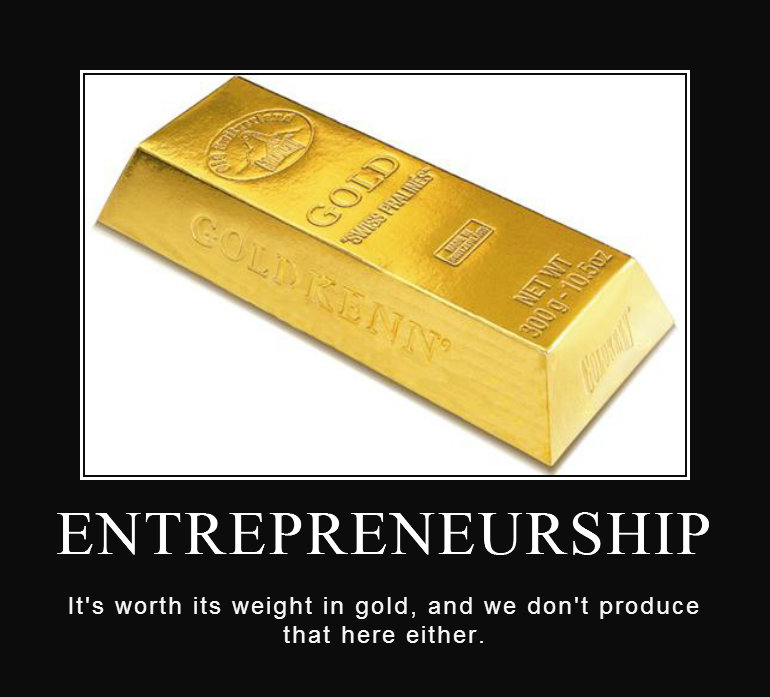
Posted: February 7, 2013 Filed under: Humor, Satire | Tags: Demotivators, humor, satire 1 CommentI was inspired recently to create a couple Demotivational posters. If you’re as much of a fan as I am (I’ve loved them ever since my sister got me a calendar several years ago), check ’em out, and be sure to go buy some so they keep producing more!

Why 90% of Everything is Crap (And That’s OK)
Posted: February 6, 2013 Filed under: Culture, Musings | Tags: culture, society 8 CommentsThe other day I made the mistake of listening to the radio. Not NPR, like I normally do, but an actual music station. I won’t call them out, but you can pretty much pick one at random and get the same experience I had. Half of the songs were absolutely terrible dreck released in the last year, another forty percent were absolutely terrible dreck released sometime in the preceding twenty years (really, how many times a day can you still play Metallica’s “The Unforgiven“?), and about one song in ten was actually worth listening to.
At first I thought this was just a sign of the times. Then I thought I was turning into the grouchy old man down the street (“when I was a kid…”). Then I got home and tried turning on the TV and was almost blinded by a commercial that included some monstrosity named “Honey BooBoo” and I thought the Apocalypse was nigh. After washing my eyes out with salt water and taking a glass of 100 proof consolation, I gave the matter some deep thought. Surely the world hasn’t changed so much from the heyday of my youth, the glorious and wonderful 80’s?
Fortunately (or perhaps unfortunately) I was unable to kid myself for long. The 80s were terrible. Sure, they brought us the death of disco (for which we should all be eternally grateful), but they also brought us parachute pants, breakdancing, MC Hammer, and closed out with Vanilla Ice. TV wasn’t a whole lot better: for every A-Team there was a Manimal; for every Remington Steele there was an After-M*A*S*H. Sure, we had the birth of MTV, but that just meant we were subjected to nonstop playing of hair metal icons like Ratt and Cinderella. And it all seemed like a good idea at the time.
The point I’m trying to make here is that 90% of everything is crap, and that’s okay. The good stuff survives, and the bad stuff is cast aside. Sure, everyone remembers classic albums like The Dark Side of the Moon, but how many people (outside of hardcore Pink Floyd fans) have even heard of The Piper at the Gates of Dawn? While there are those who would argue Piper is a great album, I’m not one of them, but history will decide. As a comparison point, I find it difficult to believe that Bach, Beethoven, and Brahms didn’t have a huge number of contemporaries. Why don’t we hear about more of their works, or know their names? And yet we hear so much about how great classical music is compared to so much of today’s music. The great work survived, and the less great work… didn’t.
And it’s like that in most fields of endeavor. The arts are the most easily recognized for this, but it’s the same way with technology or social movements as well. We try all sorts of things, and the truth is that most of it either doesn’t work or isn’t well-received. Sometimes it takes a while for things to catch on, and some things are slowly recovered from the past (people are notoriously slow to adapt to new ideas), but overall we do a decent job of filtering out the bad stuff from the good stuff; it just takes a while.
Now if I can just get that one station to stop playing Metallica.
My Favorite Movies (That You’ve Never Seen)
Posted: February 4, 2013 Filed under: Culture | Tags: culture, entertainment, movies, pop culture 5 CommentsWhether because I’ve seen some obscure movies (not that I’m a movie buff, I just watch weird stuff) or because I’m just a little older than some of my friends, I often find myself making references to movies that apparently nobody other than myself and a handful of others have seen. Mostly because this means my brilliant pop culture references end up falling on the ears of Philistines, but in some small part because it means that some piece of great cinema (loosely defined) has gone unnoticed for far too long, I’ve decided to share with you a few of my favorites.
Last week I covered some classic movies I’d like to see modern takes on. While I would highly recommend every one of those, there are some movies that are perfect just the way they are, or in at least one case, there’s no way you could possibly recapture the inane brilliance and je ne sais quoi that makes it so wonderful. If you haven’t seen these yet, I almost envy you, because you have a chance to be delighted by these hidden gems.
All That Jazz (1979) – A semi-autobiographical work directed and choreographed by legend Bob Fosse. I say “semi-autobiographical” for a couple of reasons, in part because the protagonist is named Joe Giden rather than Bob Fosse, there are certain fantastical elements, and… well, I don’t want to give away too much. Suffice to say that this film is astounding. The music is at times fun and bouncy and at other times downright lascivious, and the dancing… well, it’s Bob Fosse. One scene inspired the (in)famous Paula Abdul video “Cold Hearted”, for those of you old enough to remember that one, and to be honest she couldn’t even begin to do it justice. There’s a lot in this movie, ranging from humor to tragedy, and more than a bit of great storytelling (every time I watch it I discover some new element that I missed before). Here’s my favorite line from the movie, just to give you a taste of the kind of humor you’ll find: “Ladies and gentlemen, let me lay on you a so-so entertainer, not much of a humanitarian, and this cat was never nobody’s friend… you can applaud if you wanna…Mr. Joe Gideon!” And remember, this is Bob Fosse directing a movie – about himself. Powerful stuff.
Hudson Hawk (1991) – This is the movie critics love to hate. It has a score of 17 from Metacritic.com. Let’s put that into perspective: that’s on a scale of 100. By way of comparison, Godzilla starring Matthew Broderick got a 32. Here’s my favorite: “This may be the only would-be blockbuster that’s a sprawling, dissociated mess on purpose. It’s a perverse landmark: the first postmodern Hollywood disaster.” That’s according to Owen Glieberman of Entertainment Weekly. So why would I possibly tell you to watch this movie? Let’s take a look at what Empire has to say: “What director Lehmann has made is essentially a multi-million dollar cult movie with great effects, a witty script and some good performances, but although some of the eccentric (and occasionally slapstick) humour may not appeal to a mass audience, it is certainly one of the more original blockbusters coming out this summer.” And that’s the heart and soul of it. Bruce Willis and Danny Aiello give great comedic performances in this film, with a bit of over-the-top maudlin emotion to balance(?) things out. Andie MacDowell is passable, and Sandra Benhardt is… well, Sandra Bernhardt (either you love her or hate her). The movie is eminently quotable, like all great cult films are, and any heist film that involves an evil corporation, the CIA, the Vatican and Leonardo Da Vinci… you know what? I have no idea how to finish that sentence. Just watch the movie. Trust me.
Strange Days (1995) – Swinging back again from awful to awesome, we have the cyberpunk tech thriller Strange Days. This lush, brilliant movie manages to capture the true esthetic of cyberpunk without getting bogged down in the tech, as such movies so often do. The plot is brilliantly convoluted (deliberately so) with a delicious and satisfying ending that will make you want to watch it again. The best part for me personally is how the central tech (a form of virtual-reality life recorder) is a McGuffin; it’s a strong plot device, central but not crucial to the pot and character development. It could theoretically be accomplished even with modern equivalents, but that’s the point of cyberpunk: close enough to touch, far enough to be eerie. The music is phenomenal (for my taste), again being right in line with the esthetic, and the settings are fully realized, with great costuming and make-up all around. Everything is about style over substance, and there are clear, sharp divides between the haves and the have-nots at all levels of society. Ralph Fiennes turns in a powerful, emotional performance, Angela Bassett is both emotionally moving and powerful (physically as well as emotively), and Tom Sizemore delivers one of the most surprising and understatedly brilliant supporting roles I have ever seen. Rounding out a fabulous cast are Juliette Lewis and a small but important role from a young Vincent D’Onofrio. Well worth your time.
If I can think of more, I’ll be sure to add them in the future. If you have any “must see” obscure gems, tell me all about them in the comments below!
Taking Credit
Posted: February 1, 2013 Filed under: Culture | Tags: credit, credit cards, culture, debt, Millenials, society 7 CommentsI heard on “Marketplace” a report about how Millenials are supposedly engaging with debt, particularly credit card debt, in a very different way than previous generations. Basically they spend on credit cards until the cows come home, and then expect they can just pay it all off when they get jobs. Of course this leaves them saddled with crippling debt when they come out of college, and they are paying off debt much slower than previous generations.
I will be the first to admit I do not have the facts in this case, and I wouldn’t want to challenge those assertions without any facts. However there are some claims I do find somewhat specious, particularly the logic of “if we project that out to the end of their life using life expectancy tables, we will see that they will die with credit card debt” (direct quote there), since it assumes behavior will remain consistent over a lifetime that does not tend to remain consistent. I also notice there is a prescription slipped in there ever-so-subtly that I recognize from my own early college career, and one that has never fallen out of favor over the last twenty years: “banks need to stop giving out credit cards so generously” (again, direct quote).
Now, there is a certain temptation to turn this into a harangue about Millenials merely aping their elder statesmen and spending money they don’t have, paying as little as they can get away with and whistling past the graveyard until their credit rating gets turned to ash, but not only would that be too simple, I don’t think that’s really the case. I think this is more another example of same story, different generation. As I mentioned before, people were sounding the alarm bells of students having easy access to credit cards and not paying them off twenty years ago, and how college kids would ruin their lives with crippling debt, and you know what?
They were right. Here’s my story.
I was young and stupid. I got my hands on easy credit, and I used it. Oh boy, did I use it. If there was a way I could charge something I did, and the idea that it would bite me in the ass someday involved a vague and foggy “someday” I couldn’t seriously conceive of even if I could be bothered to think about it, and I was too busy having fun to even do that much. Until.
Until it caught up to me. The party ended, and I had to pay it all back. With interest. I had to move back in with my parents (more than once), I had to face the collection agency calls, I had to rebuild my credit score, I went through the whole thing (although fortunately I never had to declare bankruptcy). It wasn’t easy, and it had its costs. I have never owned a new car (not that I would choose to), I had to wait a lot longer than any of my friends to even buy a top of the line computer, and I had to pass up on a lot of fun that plenty of other folks my age got to have, because I had already had my fun and the piper came a-calling. Truth is, if I hadn’t had help from family and friends, I might not even have gotten off as lightly as I did.
But who dug that hole? Was it the credit card company? Was it the bank? I don’t remember them pulling out the credit card whenever I stepped into 7-11 for a pack of smokes or went out with my friends and said “I’ve got this one, guys.” I had what economists call a “high time preference” and what my mother calls “bad judgment”. My time preference has changed (or my judgment has improved), largely because of those experiences (not digging myself into the hole mind you, but digging myself out).
If we start saying to credit card companies and banks “you can’t give credit cards to this class of people based on their age” or “you have to charge higher minimum balances regardless of what your actuarial tables say” what we’re really doing is replacing our version of judgment for theirs. Yes, in some cases that will be better judgment, but not all. We don’t know what the local circumstances are for each individual. Maybe this month they just don’t have the extra money to go around; there could be an emergency, or hell, maybe this month they just feel like having an extra pizza.
Or maybe they just make bad choices all the time, and sooner or later it’s gonna catch up with them. If you take away the chance to make bad choices, you take away the chance to learn from those bad choices. I’m not saying everyone does, and I’m not saying everyone will. But in the absence of opportunity, nobody learns.
And what about the ones who didn’t make the bad choices? I had plenty of friends who did just fine, who didn’t go into debt, and who managed their money well. Should they be punished for my sins? At what age will they be “old enough” and “wise enough” to handle credit? When they have a spouse to take down with them? A family?
There are people who get hurt under the current system, it’s true; sometimes through no fault of their own they get screwed. But that can be said about any system. Before we blame the system and say “it’s got to go! We have to change it!”, we should consider: is it really worse than the next best alternative? The current system also provides many young people with a chance to establish credit history, manage cash flow, and begin to build a life.
And some of us even learn a lesson in spite of ourselves.
Remakes I’d Love to See
Posted: January 28, 2013 Filed under: Culture | Tags: culture, entertainment, Hollywood, movies, pop culture 1 CommentSo I’ve noticed a trend in Hollywierd lately of remaking all the things from my childhood, usually making it worse rather than better (Dukes of Hazard, I’m looking at you), although the occasional Michael Bay Giant Robot SmashFest Round IV manages to put a small smile on my face.
I was originally planning to bring to the attention of you, my loyal readers, some of the best movies you’ve probably never seen, when it occurred to me I could do so much more: I’ll let all the world know how these movies could be revived, remade, and (hopefully) not allowed to suck too much in the process.
Flash Gordon (1980) – Let me start by saying the following: this movie was made in 1980, it’s based off a 1930s era sci-fi comic strip and it has a soundtrack by Queen. I’m not really sure if there is any way it could be made better. Then again, in the movie Flash is the quarterback for the New York Jets, so I don’t know that it could be worse. There’s a certain way of looking at it that says “you just can’t do this without being campy”, but apparently as of a few years ago they were looking at doing just that (way down at the bottom of the interview).
For myself, I’d like to see some of the same camp, but with a little more balance toward hard sci fi. Something like what Cabin in the Woods did with horror; it had a bit of humor and campiness to it, but only as much as it needed. Considering there are plenty of real world companies pushing to get into space, there’s lots of room there for “Flash” Gordon to be a pilot with a private company pushing the boundaries, and Dale Arden can go from being a helpless maiden (in whatever guise to a lesser or greater degree) to a bit more useful partner, perhaps even as a copilot. Besides, wouldn’t it make it that much for fun for Ming the Merciless to try to enslave her (the guy is a psychopath, after all). With a soundtrack by The Killers, Fun., The Airborne Toxic Event, or possibly all of the above and more, it would be everything the 1980 movie was and better.
Pump Up the Volume (1990) – If you haven’t seen this one, I highly recommend it. It sits somewhere between comedy and drama as most teen movies from the 80s into the early 90s do, but this one went a slightly darker route (which is not surprising considering just a couple years earlier Christian Slater had been doing the dark comedy Heathers). It covers teenage angst and rebellion through the lens of pirate radio and public school, and considering the political climate of youth rebellion and schools today this one seems a perfect fit for a modern take. The existence of internet radio, satellite radio, and all the other easy to access entertainment options today almost makes pirate radio seem more interesting, sort of a “guerrilla entertainment” that would be very appealing to those looking to rebel against the corporate masters. Change it up a little bit to make it a podcast or some other form of hacking and suddenly SOPA and PIPA become an issue. BAM! Instant social relevance.
In addition to being a great vehicle for small, unknown bands, it would also be a perfect opportunity to bring back some classics. I’d love to see the Pixie’s “Wave of Mutilation” show up on the soundtrack again, and it just wouldn’t be Pump Up the Volume without Leonard Cohen’s “Everybody Knows”. For a delightful Easter egg I’d love to see Christian Slater and Samantha Mathis as the parents of our new troubled teen, and if they wanted to make it a direct sequel we could even see them reprising their original roles (and can you imagine the scene where our protagonist finds out her parents are the legendary Happy Harry Hard-on and The Eat Me Beat Me Lady? Do as I say, not as I did!) For an extra twist, don’t make it a public school, make it a charter or private school the kid is rebelling against. Can they actually do what they are doing? It may be wrong, but is it legal?
Finally I’d like to suggest Remo Williams: The Adventure Begins (1985). For those of you who think this movie is nothing but a cheap action/adventure/comedy from the mid-80s, you are so very, very wrong. Not only was it nominated for an Oscar (Best Makeup, Carl Fullerton), but the Academy of Science Fiction, Fantasy & Horror Films nominated it for a Saturn Award for both Best Fantasy Film and Best Supporting Actor (Joel Grey). Before you sneer at that one, let me note that Mr. Grey also got another nomination for Best Supporting Actor that year – a Golden Globe nomination (and he deserved it).
The fact is, this movie had a lot more style, story, and general “cool” factor going for it than the special effects of the time (makeup notwithstanding) could keep up with. It was also clearly the first in what was meant to be a series (note the subtitle), and there was a lot of room to grow. Either a complete remake or “many years later” sequel would be awesome (I would pay large sums of money either way to see Joel Grey reprise his role as Chiun). This seems like just the sort of vehicle that would work well for some of the current martial arts action stars, such as Jet Li or Jackie Chan, or perhaps another as-yet unknown to American audiences star, to serve as a serious villain (rather than the slightly silly and pathetic one we had in the original). Jason Statham could fill in as a suitable Remo Williams.
Hollywood, please, take these ideas. Make them. The only thing I ask in return is to be there for the big premiere. That’s not so much, is it? (Oh, and if you can get Christian Slater to sign my copy of Pump Up the Volume that would be awesome.)
The Social Consequence of Gay Marriage
Posted: January 25, 2013 Filed under: Culture, Politics | Tags: culture, gay marriage, law, politics, society, Supreme Court 5 CommentsThis post is a long overdue promise to The Frazzled Slacker outlining my views on gay marriage. All opinions are my own. No legal advice is intended or implied. Not taking my advice is a good idea in any case.
So at long last the Supreme Court is addressing the issue of gay marriage. I for one am thrilled, since it’s about time we get some clarity and put this issue to rest once and for all, as we have with other contention issues before.
All joking aside, I do think it’s time the high court stepped in. We have a plurality of answers on this question in different jurisdictions, and it is a matter that has implications both nationally and across state lines, which is a proper role for the Supreme Court. More so, it is a civil rights question, in that the heart of the matter is to what extent the State can and should regulate the institution of marriage.
And that right there is the first point I believe needs to be made in this debate, and one that seems to be lost in much of the heated rhetoric. Before anyone makes demands about what should and should not happen, we need to draw the lines very clearly: this is, and should remain, strictly about the role of the State in the institution of marriage. No person or group’s personal beliefs should impact, or be impacted by, these cases. If a particular religious organization wants to refuse to marry a gay couple, they should maintain the right to do so; it is theirs to decide, in the same way they can decide not to marry a straight couple on any grounds (IMNSHO).
With that out of the way, we are led to the question of “what exactly is the role of the State in the institution of marriage?” As I understand it, the State has traditionally had a handful of roles, and in recent history (the last hundred years or so) has taken on a few additional roles as well. Once we define those roles, it should be relatively easy to tease out the question as to whether or not (a) homosexuals share those rights with heterosexuals, (b) whether heterosexuals would suffer any significant harm in sharing those rights with homosexuals, and (c) whether society writ large would suffer any harm from allowing homosexuals to exercise those rights.
The traditional roles, as I understand them, are to encourage child rearing, social stability, and guide the process of inheritance. End of line. The additional roles that the government has taken on have been to grant certain rights such as tax benefits, Social Security benefits, and various and sundry other spousal benefits such as visitation rights, next of kin in medical matters, etc. to married couples.
To the first question: do homosexuals even have these rights? According to the state of Kansas, a lesbian can be a single parent, so by logical extension, a homosexual can have parental rights. While Kansas has in this case proven they prefer not to encourage child rearing, one would think it would be desirable to support couples that prefer to rear children together rather than attempt to sue someone in an iffy court case, and that’s of course assuming there was no proper waiver and doctor present to even allow a lawsuit to move forward.
As for social stability, setting aside the obvious counter-argument that rhymes with “fifty percent bivorce rate” there is the simpler counter-argument: given a choice between encouraging couples to be monogamous and stay together rather than NOT encouraging them to do so, when your purported goal is a more stable society, why wouldn’t you?
Finally, the question of inheritance is, again, simple on the face of it. Any individual has the right to assign their estate as they see fit in a will; simply assuming that next of kin would be the logical beneficiaries in the absence of such is a grace and mercy to a bereaved family, as well as relieving an overburdened court system. Insisting that one segment of the population does not have that right and must go through an onerous process by virtue of who they love is demeaning and unbefitting of a civilized society.
Most spousal benefits are in the same category as inheritance; they can, with time, money and effort be resolved through other legal means (power of attorney, etc.). It is simply demeaning to insist that one segment of the population is required to climb an extra hurdle because they have a consensual relationship between two adults that others do not approve of (c.f. miscegenation). The only exceptions are such things as Social Security and tax benefits, so I shall address them as such: are homosexuals exempt from paying Social Security and other taxes in ways I am not aware of, or do they receive other special benefits to compensate them for their inability to access these benefits?
Moving on to the question of whether heterosexuals would be significantly harmed by sharing these rights with heterosexuals. That’s a bit of a tricky one, because there are two important words there: significant and harm. Would I be “harmed” if someone else were paying lower taxes? Arguably, yes. Would it be significant? If they did so in large enough numbers, maybe. Does that mean I should be able to deny them their rights? I do not see how. True harm is if I were to lose something I were otherwise entitled to, and I am not entitled to having first claim on someone else’s life, their labor, or their choices, so long as those choices do not interfere directly with my ability to make choices. And seriously, I don’t see how homosexuals choosing to marry impacts any heterosexual’s choices, unless they have secrets they aren’t sharing (in which case the statement is still valid).
Would society suffer any significant harm in allowing homosexuals to exercise their rights? Again, it depends on how you define society and how you define harm. Considering the potential good outlined above, and the societal purposes that marriage serves in the first place, I see no evidence that expanding the civil tradition of marriage could bring. There will be those who will not be able to accept this gracefully, and they may even commit violent acts in response. This would not be a direct result of allowing homosexuals to exercise their rights; this would be a result of people who are unable to accept change attempting to use violence and fear to coerce others when all else fails. There is a word for that: terrorism. It should be dealt with as such.
In the final analysis, there is no good reason to continue to deny a significant portion of our population the same rights that the majority have enjoyed for so long. The Supreme Court should step in and, as it has a few times in its long history, strike down the laws of oppression and let liberty carry the day.
 . And be sure to leave a review with your not so humble opinion!

 My Not So Humble Opinion